Thursday, October 11, 2007


Zodiac features three removable neck pieces. It was created from two pieces of plywood supports which were covered with a variety of hand made papers and coated with medium. The face of the figure was formed from polymer clay and painted with acrylics, and mounted on top of a brass crab which my friend Brenda recovered from her property after Katrina. The Body was once a tin ceiling tile that graced a house in pre-Katrina New Orleans. The arms are fragments of one of my bracelets which my husband found in the back almost a year after Katrina, and the leaves were taken from a smashed basket. The neck pieces include beads of stone, glass, and acrylic, as well as African brass kirdi beads and African trade beads, and a Chinese coin. 28" x 28" SOLD

Sunday, March 25, 2007


Ghost Dance is a survivor of Hurricane Katrina, one of the few pieces of art with which I evacuated. It is the first one of a series I did about the Ghost Dance phenomenon. Growing up in South Dakota, I was heavily influenced by the culture of the Plains Indians. My fascination with Native culture is apparent in much of my work, and especially in this series.

I began this piece with an unusually shaped scrap of iron I picked up in a salvage yard. I layered the metal with a thin silver piece of sheet metal, an oversized reproduction of an Indian Head penny, a cylindrical metal choker and another odd shaped piece of metal, a hoop of copper tubing and sheet metal copper cut in the shape of sun rays, two metal Turkish crosses, a bent fork, and copper flashing strips and nails. The beads are of stone, glass and ploymer clay, and the support for the piece is painted plywood.

The Ghost Dance was a phenomenon which swept the Western Native American communities in the late 1800s. It began when a Paiute prophet named Wovoka prophesied a nonviolent end to white American expansion while preaching messages of clean living, an honest life, and cross-cultural cooperation. During a vision, Wovoka stated that he was given the Ghost Dance and commanded to bring it back to his people. He preached that if this five day dance was performed in the proper intervals, the performers would secure their happiness and hasten the reunion of the living and deceased. As the Ghost Dance spread from its original source, Native American tribes synthesized selective aspects of the ritual with their own beliefs–often creating change in both the society that integrated it and the ritual itself.

The Lakota interpretation of Wovoka's message was drawn from the idea of a “renewed Earth” in which all evil was to be washed away, including the European presence on their homelands. By 1890, this seemed to be the only way out of a desperate situation, and the Ghost Dance began to be performed frequently among the Lakota. The dances alarmed many reservation officials, and troops US troops were called in to discourage the events. On December 28, a small band of Sioux erected their tipis on the banks of Wounded Knee Creek. The following day, US forces opened fire on the camp. When the fighting had concluded, 25 U.S. soldiers and 153 Lakota-mostly women and children- lay dead. The Massacre at Wounded Knee effectively ended the Ghost Dance phenomenon, and Native resistance on the Plains.

"Fertility" is a piece which did not survive Katrina. I keep hoping that I will find one of the necklaces which graced this assemblage-especially the lower one, which was modeled after a fertility necklace from Nepal.

Saturday, March 24, 2007

"Lakota" was a mixed media construction which was built around a traditional, ceremonial "dance stick" of the Lakota people. It was comprised of wood, leather, trade cloth, copper, acrylic, buffalo teeth, feathers, and beads of glass and bone, including some old trade beads. It featured a removable neckpiece with beads of bone, glass, wood, and old African trade beads. Adios to this one too.


"Mask"is another one that didn't make it through the storm. Haven't seen any part of this one, either.

Tuesday, March 20, 2007

"Three Virtues of a Chinese Gentleman" was a mixed media construction which included handmade paper, wood, carved bone, turquoise, amber, African brass kirdi beads, Chinese coins, and sterling silver beads from Asia. It featured a removable neckpiece for personal adornment. It was another one of Katrina's victims.
"Totem" is still with me. I evacuated with this one because it was one of my favorites, and it has been in storage ever since Katrina. It is a mixed media construction which includes trade cloth, burlap, turtle shell, pottery shards, old brass thimbles, Indian head pennies, feather, and beads of glass, turquoise and amber. Much of the inspiration for this piece comes from the Lakota culture of the Northern Plains. The turtle symbolized long life for the Lakota, and and the trade cloth, thimbles, and beads were important elements in the people's economic well being in the 1800s. It features a removable neckpiece for personal adornment.

Monday, January 1, 2007


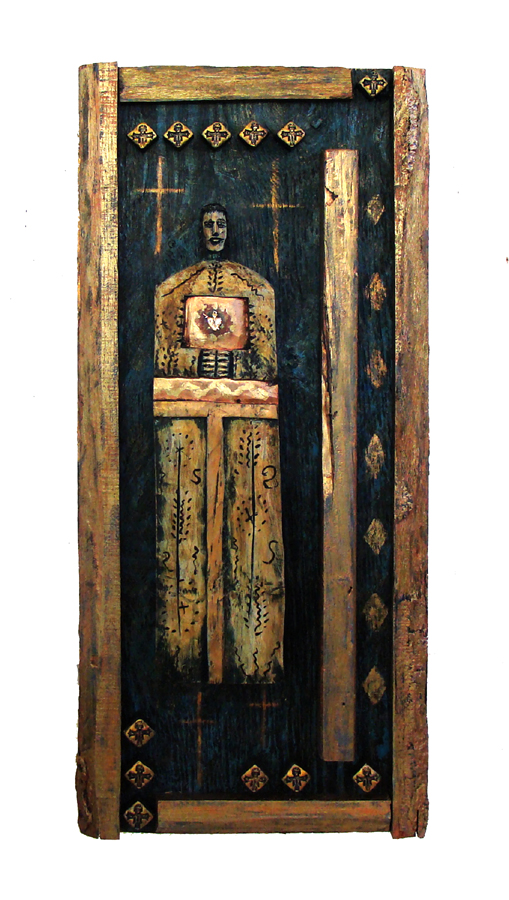
The Santo in Seventeen Crosses is mounted upon painted plywood and surrounded by crosses made of wood and polymer clay. A milagro rests upon the Santo's chest, and copper nails further embellish the piece. SOLD
Icon and Altar began with the small three paneled folding icon. I placed it on top of an altar fashioned from polymer clay, and nestled in a niche formed from a box salvaged from a Katrina debris pile. The support for the piece is plywood, and the small icons are of polymer clay. 15" x 19" x4" SOLD

Leda and the Swan. This piece was made from a beautiful ceramic tile from Cyprus, a fragment of a small drawer, and a slate roof tile from New Orleans. 11" x 15" SOLD
Floral SOLD


Angst of the Artist. I created this tongue-in-cheek piece for a fundraiser. Artists were supplied with a plywood mask form and asked to build a piece from that. I pretty much hid the mask behind feathers made from painted canvas, and attached a wood doll to the front. The doll represents the artist, offering her work to the viewer. Her wings represent her wish that her work soar, but behind the feathers, in the eye holes of the mask, are two polymer clay faces which reveal self-doubt and insecurity. I meant for this piece to poke fun at myself and other artists and in a larger sense, to help us to remember that while the creation of our art may be personally satisfying, it ain't a solution for world peace and it ain't a cure for cancer. SOLD

Virgin and Child in Ornate Frame SOLD
Virgin and Child 2 SOLD
Virgin and Child Icon SOLD
Three Icons SOLD

St George Icon SOLD

Muse SOLD
Joss Icon SOLD
John the Baptist Icon 3 SOLD